
Is The Trinity Logical? Yes.
IQ

According to Muslims, because the doctrine of the Christian Trinity is not “logical” to them it means that the Trinity is false, or at the very least they consider themselves justified in rejecting believing in it.
That the Trinity may not seem logical to someone does not logically entail that the Trinity itself is indeed illogical. The doctrine of the Christian Trinity, specifically Monarchy of the Father as taught by the Orthodox Church, is true. People just fail to grasp it, whether it is due to not properly understanding what the doctrine actually is, illogical thinking, and/or because of intellectual limitations.

For example, just because you may not logically know all the details how your cellular phone works does not mean that it does not work. You continue to use your cellular phone because it works even though you have no idea how it works. Now, how about this: do not utilize anything in your life that you yourself do not logically understand how it works. Good luck. That is basically the argument Muslims make when they say that the doctrine of the Christian Trinity is not “logical”.
The Eunomian premise is an age-old idea within Christianity that has led to numerous Arian-based heresies. The premise can be stated in various ways. Perhaps the simplest is as follows: Aseity is essential to the Divine essence. In other words, to be Divine is to exist a se (from oneself). Another way of formulating the premise is: It is impossible to have the Divine nature and be ab alio (from another). According to Orthodox Christianity, the Father is a se, while the Son is begotten (of the Father).
The central idea behind the Eunomian premise is Arianism, meaning to deny Divinity to the Son, or at least to deny the Son the same essence as the Father. In other words, the Father and Son are not homoousios, i.e., of the same essence.
The Eunomian premise is at the heart of Muslim critiques against the Trinity. The Muslim argument is basically the following: Causation entails creation, since the Son is caused (begotten) this entails that He is created, and if the Son is created then He is not Divine. Therefore, the Trinity is false. This Muslim line of reasoning is faulty because of the premise “causation entails creation”. Orthodox Christianity rejects this premise, and Muslims cannot logically prove its validity — only assert it.
It must be stressed: The Eunomian premise has never been proven logically. It has only ever been asserted.
Courtesy of Dr Beau Branson, utilizing modal logic (https://www.umsu.de/trees/) we present three various formulations of the Eunomian premise and demonstrate the corresponding logical conclusions.
You can watch Branson demonstrate and discuss this in an interview conducted on our corresponding YouTube channel:
EUNOMIAN PREMISE
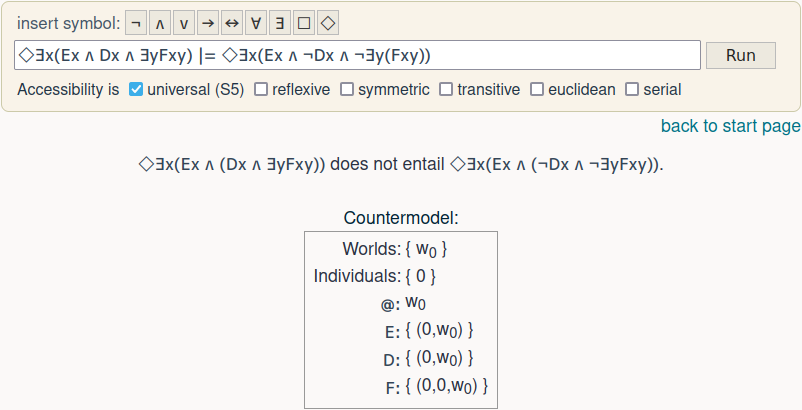
¬◇∃x(Ex ∧ Dx ∧ ∃yFxy)
HYPOTHESIS
◇∃x(Ex ∧ Dx ∧ ∃yFxy) |= ◇∃x(Ex ∧ ¬Dx ∧ ¬∃y(Fxy))
DEFINITIONS
x exists: Ex
x is Divine: Dx
x is ab alio: ∃yFxy
Possible something exists that is Divine and is from another: ◇∃x(Ex ∧ Dx ∧ ∃yFxy)
Possible something exists that is not Divine and is a se: ◇∃x(Ex ∧ ¬Dx ∧ ¬∃y(Fxy))
CONCLUSION
That it is possible something exists that is divine and from another does not entail that it is possible something exists that is not Divine and is a se (e.g., an a se cow).
EUNOMIAN PREMISE
¬◇∃x(Ex ∧ Dx ∧ ∃yFxy)
HYPOTHESIS
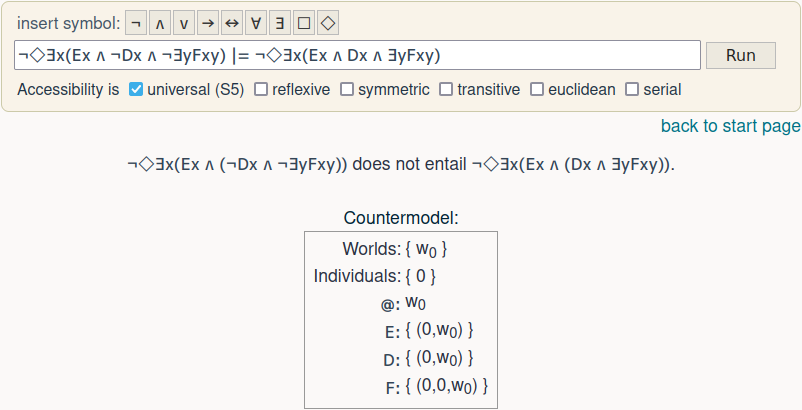
¬◇∃x(Ex ∧ ¬Dx ∧ ¬∃yFxy) |= ¬◇∃x(Ex ∧ Dx ∧ ∃yFxy)
DEFINITIONS
x exists: Ex
x is Divine: Dx
x is ab alio: ∃yFxy
Not possible something exists that is not Divine and is a se: ¬◇∃x(Ex ∧ ¬Dx ∧ ¬∃yFxy)
Not possible something exists that is Divine and is not a se: ¬◇∃x(Ex ∧ Dx ∧ ∃yFxy)
CONCLUSION
That it is not possible something exists that is not divine and is a se does not entail that it is not possible something exists that is divine and is not a se. Basically, given that all contingent existents have a cause, the converse does not logically follow, namely, that which has a cause is contingent. Furthermore, that a contingent existent has a cause does not necessitate one prove its contingency as stemming from that cause, i.e., there are other ways to demonstrate contingency apart from an existent's cause.
EUNOMIAN PREMISE
¬◇∃x(Ex ∧ Dx ∧ ∃yFxy)
HYPOTHESIS
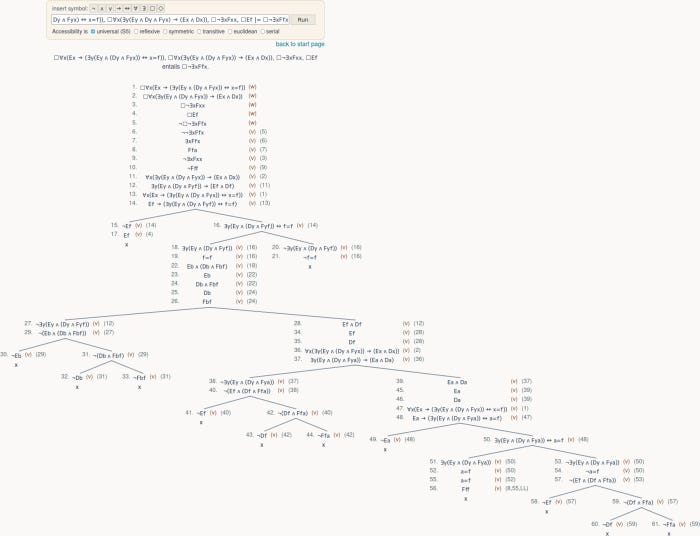
□∀x(Ex → (∃y(Ey ∧ Dy ∧ Fyx) ↔ x=f)), □∀x(∃y(Ey ∧ Dy ∧ Fyx) → (Ex ∧ Dx)), □¬∃xFxx, □Ef |= □¬∃xFfx
DEFINITIONS
Hypostatic property of Father to generate a Divine person: □∀x(Ex → (∃y(Ey ∧ Dy ∧ Fyx) ↔ x=f))
Only Divine person can generate a Divine person: □∀x(∃y(Ey ∧ Dy ∧ Fyx) → (Ex ∧ Dx))
Nothing can generate itself: □¬∃xFxx
The Father is necessarily existent: □Ef
Necessarily the Father is a se: □¬∃xFfx
CONCLUSION
Aseity is a hypostatic property of the Father and not the divine nature, i.e., you can have a divine person other than the Father that is not a se.
CONCLUDING REMARKS
Using modal logic, we demonstrate that:
Something exists that is Divine and from another without entailing that it is possible something exists that is not Divine and is a se (e.g., an a se cow);
Something exists that is not Divine and is a se without entailing that it is not possible something exists that is Divine and is not a se; and
Aseity is a hypostatic property of the Father and not the Divine nature, meaning you can have a Divine person other than the Father that is not a se.
Orthodox Christians are logically justified to believe in the doctrine of the Trinity. On the other hand, Muslims are not logically justified in utilizing the Eunomian premise as grounds for critiquing the Trinity, just like the Arians of old. Furthermore, Muslims do not have a single logical argument to critique Orthodox Christianity. Put another way, Orthodox Christianity refutes every single attack against it by Muslims.
Logic and reason only uses what is already known. As we are limited creations and God is none of those, we can only ever know a little of what He reveals to us about Himself.
What is more, the Trinity is a description, and a description is not "The Thing". You may describe a tree, but the tree is not what you describe. A man may describe a woman, but the woman can never be grasped even by himself in his best description, even were he a poet. Even even a poet can never describe a woman, and all his life will be a trail through a dark forest of describing love, how can he ever describe God?
And yet, here comes some theologist presuming to describe God Himself. And then all of Christianity is supposed to take him seriously.
I am a christian, but Jesus Christ is the Son of God is enough for me, because I am not a poet